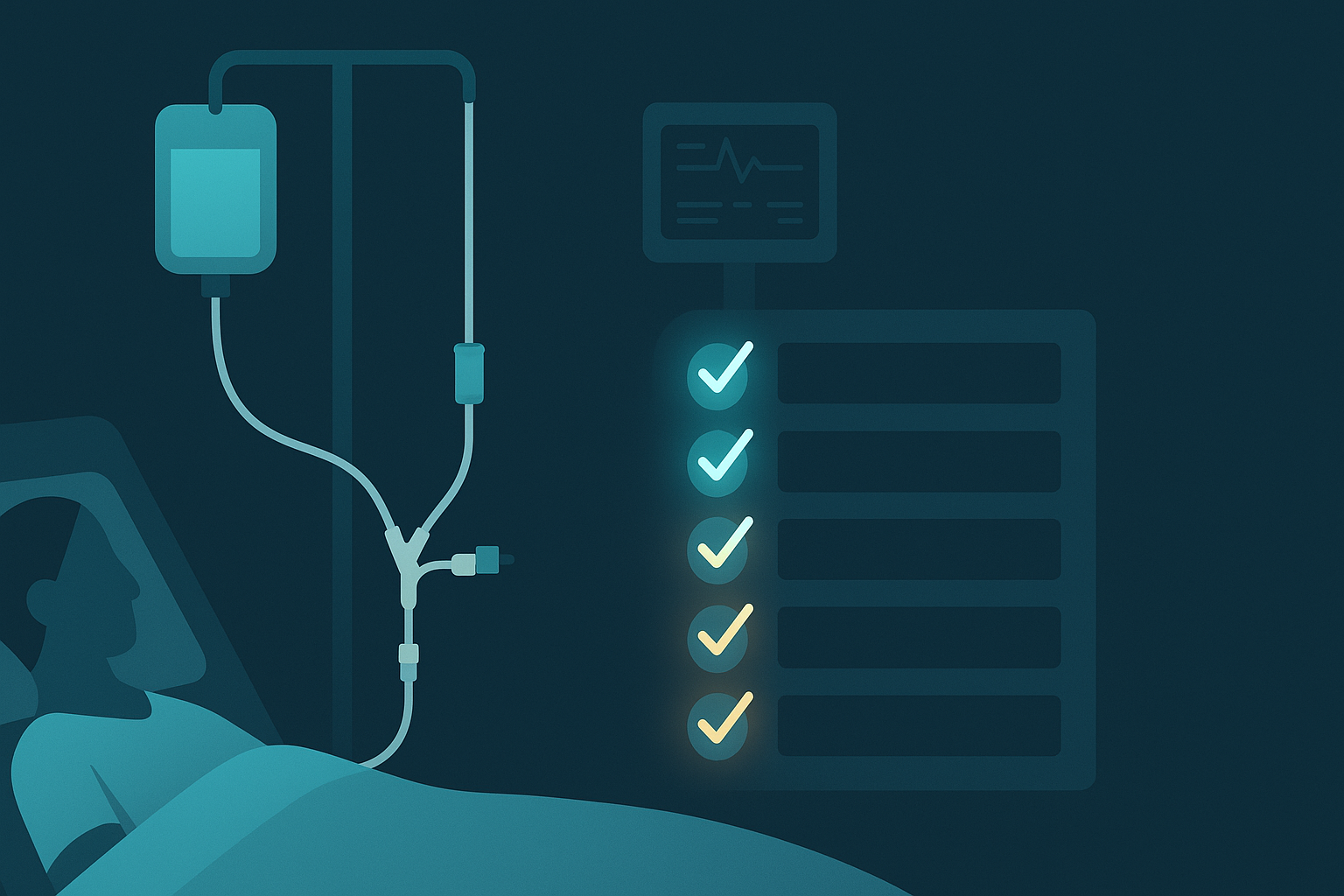
A central venous catheter is a tube threaded into a large vein to deliver drugs and fluids to critically ill patients. It is also a direct highway for bacteria into the bloodstream, and the infections it can cause - central-line-associated bloodstream infections, or CLABSIs - are dangerous, expensive, and, it turns out, largely preventable. The story of how one physician proved that is among the most important in modern patient safety.
Five steps everyone already knew
In 2004, critical-care physician Peter Pronovost of Johns Hopkins launched the Keystone ICU project across intensive care units in Michigan. The intervention was almost insultingly simple: a checklist of five evidence-based, CDC-recommended steps that clinicians were supposed to follow when inserting a central line. As reported in the New England Journal of Medicine, the five procedures were:
- Wash hands with soap.
- Clean the patient’s skin with chlorhexidine antiseptic.
- Use full-barrier precautions (sterile drapes over the whole patient).
- Avoid the femoral (groin) site where possible.
- Remove unnecessary catheters.
None of this was new. Every step was already standard, already taught, already “known.” The problem was not knowledge; it was reliability - doing all five, every time, under pressure, at three in the morning.
The result
The effect was extraordinary. Across 103 ICUs in 67 Michigan hospitals - representing roughly 375,757 catheter-days of data - the median infection rate fell from 2.7 per 1,000 catheter-days to zero within the first three months and stayed there. The mean rate dropped from 7.7 to 1.4 at 16 to 18 months of follow-up (p<0.002) (Pronovost et al., NEJM, 2006).
Atul Gawande, who chronicled the project in The New Yorker, translated the statistics into human terms:
“Within the first three months of the project, the infection rate in Michigan’s I.C.U.s decreased by sixty-six per cent […] In the Keystone Initiative’s first eighteen months, the hospitals saved an estimated hundred and seventy-five million dollars in costs and more than fifteen hundred lives. The successes have been sustained for almost four years - all because of a stupid little checklist.”
Of Pronovost himself, Gawande wrote a line that has become famous: “his work has already saved more lives than that of any laboratory scientist in the past decade.”
Why a checklist was the wrong first answer - and the right one
The most instructive detail is what the checklist revealed. When executives went looking, they discovered that chlorhexidine soap - step two - “was available in fewer than a third of the I.C.U.s.” No amount of reminding staff to use it would help if it was not stocked. Within weeks the supply was fixed, and the manufacturer Arrow International was persuaded to produce a central-line kit that included both the sterile drape and the chlorhexidine in one package.
That is the deeper lesson. The checklist did not work because doctors had forgotten how to wash their hands. It worked because it turned a vague expectation into a specific, checkable behavior, and because using it exposed the system failures - missing supplies, no barrier to skipping steps - that made reliability impossible. A checklist is a diagnostic instrument as much as a to-do list.
From one state to a country
The approach scaled. Built on Keystone, the US national program “On the CUSP: Stop BSI” recruited more than 1,000 hospitals and roughly 1,800 units - over a quarter of American adult ICUs - and reduced CLABSI rates by about 41%, from 1.915 to 1.133 infections per 1,000 line-days, according to AHRQ. The share of units going a full quarter with zero infections rose from 30% to 68%.
The Keystone story endures because it reframed a whole category of harm. Bloodstream infections had been treated as an unavoidable cost of intensive care - regrettable, but expected. Pronovost showed they were a process failure, and that the fix cost almost nothing. The most powerful tool in the ICU that year was a laminated card.
Sources
- Pronovost P, et al. “An Intervention to Decrease Catheter-Related Bloodstream Infections in the ICU.” New England Journal of Medicine, 2006;355(26):2725-2732. https://www.nejm.org/doi/full/10.1056/NEJMoa061115
- Atul Gawande, “The Checklist.” The New Yorker, December 10, 2007. https://www.newyorker.com/magazine/2007/12/10/the-checklist
- AHRQ, “Eliminating CLABSI: A National Patient Safety Imperative” (On the CUSP: Stop BSI, final report). https://www.ahrq.gov/hai/cusp/clabsi-final/clabsifinalsum.html
- Pronovost PJ, Watson SR, Goeschel CA, et al. “Sustaining Reductions in Central Line-Associated Bloodstream Infections in Michigan Intensive Care Units: A 10-Year Analysis.” American Journal of Medical Quality, 2016;31(3):197-202. https://psnet.ahrq.gov/issue/sustaining-reductions-central-line-associated-bloodstream-infections-michigan-intensive-care