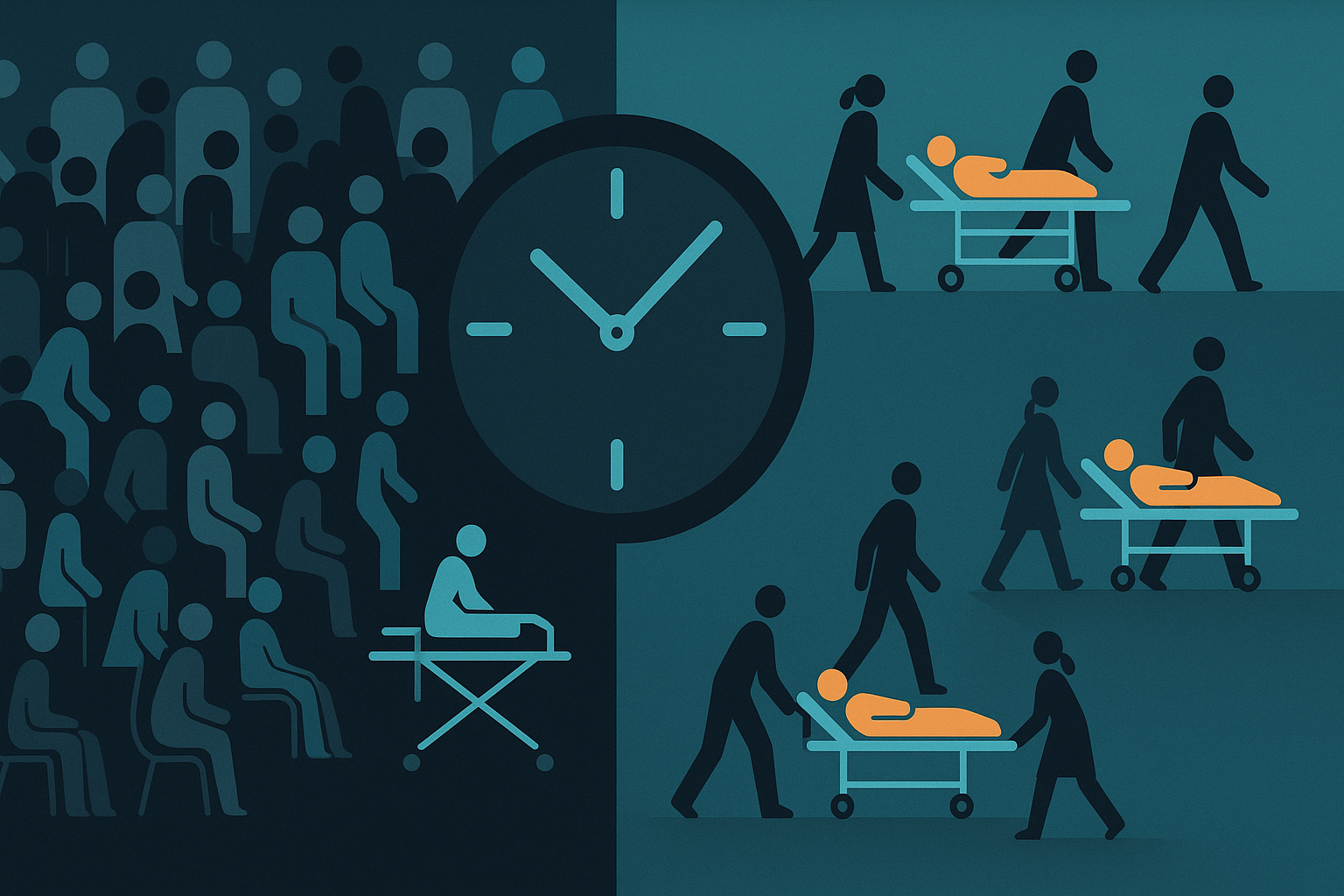
A crowded emergency department is easy to read as an inconvenience - long waits, full chairs, frayed tempers. The research tells a harder story: crowding and boarding are associated with patients dying who would otherwise have lived. Treating ED flow as a safety problem, not a comfort problem, changes what a hospital is willing to do about it.
The mortality signal
The most cited evidence comes from a study of 995,379 admissions across 187 California hospitals. On days when the emergency department was highly crowded, admitted patients had 5% greater odds of inpatient death (95% CI 2%-8%), along with slightly longer stays and higher costs. In a sensitivity analysis, high crowding was associated with 9% greater odds of dying in hospital within three days (Sun et al., Annals of Emergency Medicine, 2013).
The mechanism is largely boarding - holding admitted patients in the ED because no inpatient bed is free. A retrospective cohort of 41,256 admissions found a clear dose-response: mortality was 2.5% for patients boarded less than 2 hours versus 4.5% for those boarded 12 hours or more (Singer et al., Academic Emergency Medicine, 2011). Mean hospital length of stay climbed with boarding time too. And the harm starts early - a recent analysis of more than 170,000 encounters found that among patients who deteriorated within 48 hours, nearly half did so while still in the ED.
This is why the American College of Emergency Physicians treats boarding - which it defines as holding an admitted patient in the ED for 120 minutes or more after the decision to admit - as a patient-safety threat rather than a throughput statistic.
What “good” looks like: the four-hour idea
The best-known systemic response is England’s four-hour A&E standard, introduced in 2004 - originally a 98% target, relaxed to 95% in 2010 - requiring that patients be admitted, transferred, or discharged within four hours. Analysis by the Institute for Fiscal Studies linked the target to lower mortality after an A&E visit, and the standard remains enshrined in the NHS Constitution.
The cautionary half of that story is just as instructive: England has not met the 95% standard nationally since 2015, and performance has hovered far below it in recent years. A target creates pressure and visibility; it does not, by itself, create capacity. In the United States, The Joint Commission took a softer route, adopting a patient-flow standard (LD.04.03.11) effective in 2014 that requires hospitals to measure boarding and set improvement goals, with a recommendation that boarding not exceed four hours.
The process fixes that actually move the numbers
Between the diagnosis (crowding kills) and the constraint (you cannot always add beds) sits process design. Three approaches have peer-reviewed support:
Lean redesign of the front end. At the American University of Beirut Medical Center, a Lean project cut mean door-to-doctor time from 40.0 minutes to 25.3 minutes (p<0.001) - a 37% reduction - while also shrinking length of stay for both admitted and discharged patients and, importantly, reducing process variability so the department behaved more predictably (El Sayed et al., Medicine, 2015).
Split-flow / streaming. Separating patients early by acuity and expected effort - a fast lane for the quick cases, focused attention for the sick - repeatedly shows gains. Front-end split-flow redesigns have reported large reductions in door-to-physician time and fewer patients leaving without being seen, even as volumes rise.
Attacking boarding upstream. Because ED crowding is often caused by bottlenecks elsewhere in the hospital - slow discharges, ward bed shortages, inefficient bed-cleaning turnover - the most effective flow work frequently happens outside the ED entirely. The queue at the front door is a symptom of the plumbing behind it.
The takeaway
The emergency department is the hospital’s early-warning system, and crowding is the alarm. The evidence is strong enough that flow should be governed like any other safety indicator - measured, made visible, and owned by the whole hospital rather than blamed on the department that happens to hold the overflow. Shorter waits are the visible reward. Fewer avoidable deaths are the real one.
Sources
- Sun BC, Hsia RY, Weiss RE, et al. “Effect of Emergency Department Crowding on Outcomes of Admitted Patients.” Annals of Emergency Medicine, 2013. https://pmc.ncbi.nlm.nih.gov/articles/PMC3690784/
- Singer AJ, Thode HC, Viccellio P, Pines JM. “The Association Between Length of Emergency Department Boarding and Mortality.” Academic Emergency Medicine, 2011;18(12). https://pubmed.ncbi.nlm.nih.gov/22168198/
- El Sayed MJ, et al. “Improving Emergency Department Door to Doctor Time and Process Reliability: A Successful Implementation of Lean Methodology.” Medicine (Baltimore), 2015. https://pmc.ncbi.nlm.nih.gov/articles/PMC4620816/
- Nuffield Trust, “A&E waiting times.” https://www.nuffieldtrust.org.uk/resource/a-e-waiting-times
- American College of Emergency Physicians, “Emergency Department Boarding and Crowding.” https://www.acep.org/administration/crowding--boarding