In short: Hospital reporting obligations are the legally or contractually prescribed submissions of case, structural, quality and staffing data to authorities, payers and the public. In Germany they run in parallel: case data to the InEK by 31 March, an annual quality report, quarterly nurse staffing reports and a monthly public transparency directory. Physicians and nurses spend on average close to three hours a day on documentation and proof-of-compliance duties (Deutsches Krankenhausinstitut, survey of 400 hospitals, September 2025). The largest lever is to capture each figure once at its source and keep it visible on the ward.
It is 21:40 on a Tuesday. The ward manager has handed over, the shift is closed, and a spreadsheet is open. Twelve shifts to reconcile for the quarterly staffing report, a hygiene tally for the annual quality report, and an e-mail from medical controlling about case numbers in a public directory. None of that work reaches a patient, and all of it is due.
What are hospital reporting obligations?
Hospital reporting obligations are legally or contractually prescribed submissions through which a hospital transmits its case, structural, quality and staffing data to authorities, self-administration bodies, payers and the public within fixed deadlines. They arise from social law, hospital financing law and quality contracts. Their defining feature is repetition: the same facts, every quarter and every year, in different formats.
Which submissions does German law demand?
Two duties form the foundation for every licensed hospital. Under § 21 of the Krankenhausentgeltgesetz, each hospital transmits case-level records to the data office at the Institut für das Entgeltsystem im Krankenhaus (InEK) “jeweils zum 31. März für das jeweils vorangegangene Kalenderjahr”: coded diagnoses and procedures, the service group per case, and structural data down to staff by profession, full-time equivalent and department.
The second duty is the structured quality report. § 136b Abs. 1 Satz 1 Nr. 3 SGB V governs “Inhalt, Umfang und Datenformat eines jährlich zu veröffentlichenden strukturierten Qualitätsberichts”. Its content explicitly covers patient safety, risk and error management, medication safety, hygiene and staffing figures, and the hospital publishes it on its own website.
The same paragraph requires proof of minimum volumes for planned procedures “bei denen die Qualität des Behandlungsergebnisses von der Menge der erbrachten Leistungen abhängig ist”. A hospital that cannot evidence the volume loses the procedure.
What does nurse staffing regulation require?
Nursing reports on its own, shorter clock. The Pflegepersonalbemessungsverordnung requires target-versus-actual staffing at the InEK every quarter, due one month after the quarter closes, with reimbursement reductions for hospitals that fail to deliver.
In parallel, the Pflegepersonaluntergrenzen-Verordnung sets how many patients per shift one nurse may care for across 18 pflegesensitive Bereiche, monitored as monthly averages.
These two rules explain why reporting obligations land on the ward. The figure is created in the early shift, the deadline runs in administration, and a spreadsheet sits in between. 96 percent of surveyed hospitals consider the bureaucratic effort of the staffing-measurement instruments too high (Deutsche Krankenhausgesellschaft, 2026).
What does the Bundes-Klinik-Atlas do with this data?
It makes them public and comparable. The Krankenhaustransparenzgesetz introduced § 135d SGB V and the Transparenzverzeichnis, online as the Bundes-Klinik-Atlas since 17 May 2024 and run by the Gemeinsamer Bundesausschuss since the Krankenhausreformanpassungsgesetz took effect on 15 April 2026.
The atlas is fed from data hospitals already delivered: the § 21 records, the quality-assurance procedures and the structured quality reports. According to the G-BA it is updated “monatlich mit den jeweils neusten verfügbaren Daten”.
Case numbers, service groups, minimum volumes and a hospital’s Pflegepersonalquotient now stand online as a profile that patients, referrers and journalists read. A figure transmitted wrongly in March is publicly wrong from the following month on.
How do hospitals in Austria and Switzerland report?
Both countries reach the same result along a different route. Austria measures outcome quality through Austrian Inpatient Quality Indicators (A-IQI), “ein Verfahren zur Messung von Ergebnisqualität aus Routinedaten, das seit dem Jahr 2012 bundesweit in allen Fonds- und PRIKRAF-Krankenanstalten implementiert ist”. Deviations enter a peer-review procedure, and the results go into public quality reporting and onto kliniksuche.at.
In Switzerland the duty is anchored in contract, which makes it no less binding. The ANQ coordinates the national quality measurements in acute somatic care, rehabilitation and psychiatry, and “alle Spitäler und Kliniken, die dem Nationalen Qualitätsvertrag beigetreten sind, müssen sich an den Messungen beteiligen”. Art. 58a KVG anchors quality contracts covering measurement, improvement, verification, publication and sanctions, with results published down to the individual hospital.
For a hospital anywhere in the German-speaking region the pattern is identical: a KPI is a delivery with a deadline and an audience.
Who inside the hospital carries the burden?
Management signs, the ward delivers. In September 2025 the Deutsches Krankenhausinstitut surveyed 400 hospitals on behalf of the Deutsche Krankenhausgesellschaft: physicians and nurses spend on average a third of their daily working time on documentation and proof-of-compliance duties, close to three hours a day.
Converted into people, that is “rund 137.000 Pflegekräfte und 66.300 Ärzte” occupied with documentation alone. 34 percent of hospitals hired additional medical or nursing staff because of it. The duties named as costing the most time for the least visible benefit: requests from the Medizinischer Dienst, quality-assurance checklists and the staffing-measurement instruments.
Henriette Neumeyer, deputy chair of the DKG board, sums up the distinction - paperwork goes far beyond the documentation care actually needs:
“Schreibarbeit geht weit über die notwendige medizinische und pflegerische Dokumentation hinaus.”
Reduce documentation by one hour per day and full-time equivalent, and the DKG’s own arithmetic frees “22.100 Vollkräfte im ärztlichen und 48.900 Vollkräfte im pflegerischen Bereich” for patient care.
Why collecting the figures by hand reaches its limit
Three reasons, none of which shrinks by working harder.
The cadence does not match. The facts are created per shift, the submissions are due per quarter and per year. Whatever goes uncaptured has to be reconstructed later from rosters, records and memory.
The sources sit apart. Case data lives in the hospital information system, staffing in the roster, results in the lab system, infections in hygiene surveillance. Each report joins a different subset, and each manual join is an opportunity to define “occupancy” differently than last quarter.
Hand-made copies drift, and this one is measured. In June 2024 the Deutsches Krankenhausinstitut surveyed 412 hospitals about the newly launched Bundes-Klinik-Atlas: “79 % der Allgemeinkrankenhäuser in Deutschland haben fehlerhafte Informationen zu ihrem Krankenhaus im Bundes-Klinik-Atlas identifiziert” - wrong or missing departments, emergency-care levels, case, bed and nursing-staff numbers. That is a survey of perceived errors rather than an audit, and part of the fault may sit in the atlas itself. As a statement about the chain from ward to directory it stays uncomfortable.
How the figures reach a board without extra data entry
The answer from lean management in hospitals is to capture each figure once at its source and make it visible where the work happens. A KPI a team looks at every morning in a ten-minute huddle is already current when the quarterly submission falls due. The evidence behind visible status boards is covered in the article on visual management in the hospital.
Peakboard is a low-code platform for real-time dashboards from industry (manufacturing and logistics), whose boards work just as well for wards, emergency departments and operating theatres. Such a board reads values out of systems like SAP, SQL Server databases, OPC UA or Excel and keeps them current without extra data entry; values a team enters itself are stored centrally in Peakboard Hub Lists. The documented deployments come predominantly from production and warehousing, so a ward board extends those industrial principles rather than reporting a published clinical outcome.
This can be tried without an IT project: the Peakboard Designer is free, and for hospitals there is a ready-made template, the digital huddle board for daily management in the hospital. It visualises the five most important KPIs of a ward, staff confirm on the touchscreen each day whether they were met, and the board keeps that history for an automatic trend evaluation.
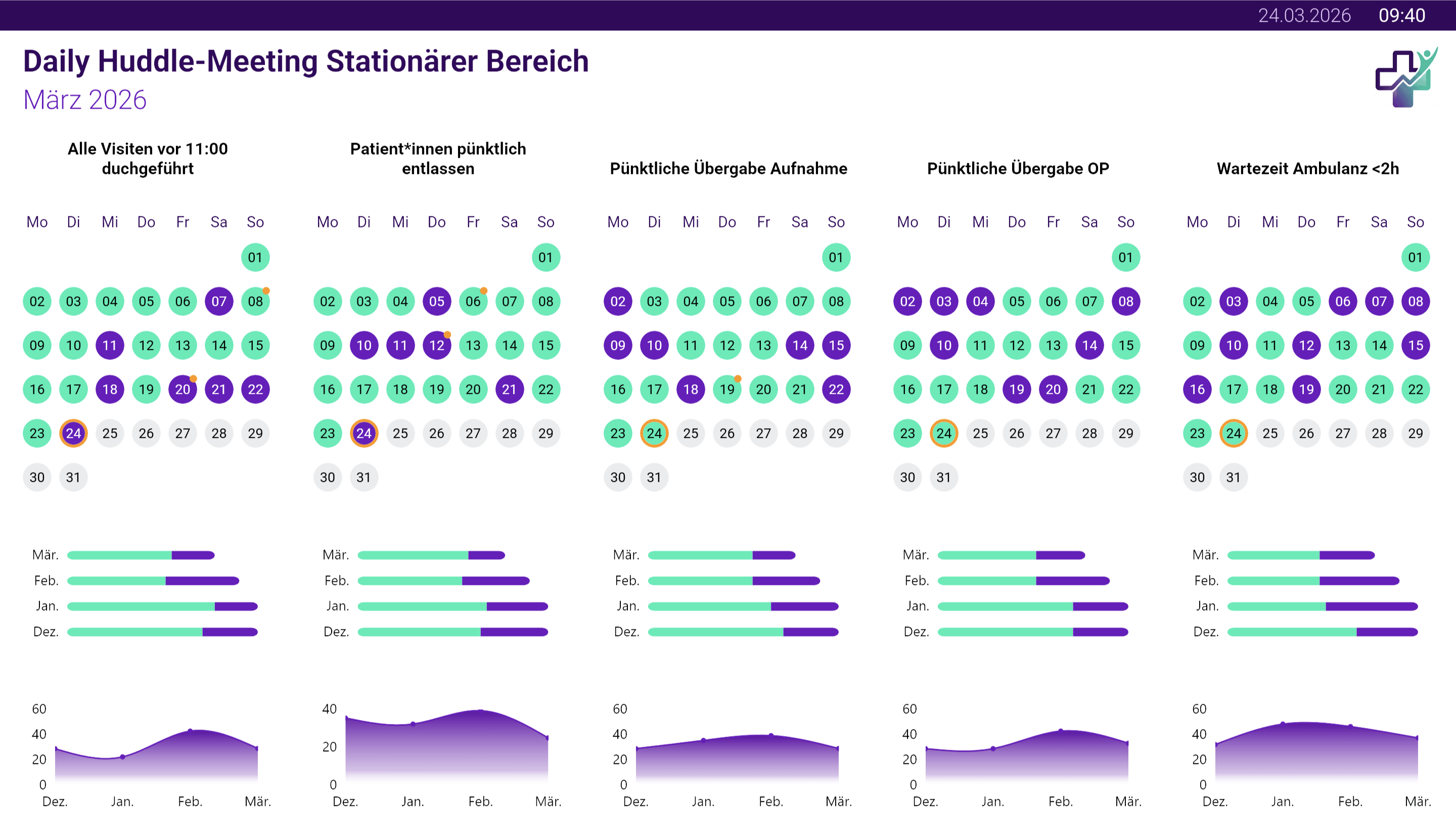
The complete template: one circle per day and KPI — green for met, purple for missed — with the monthly comparison and trend line below.
The board can be seen without installing anything in the live demo in your browser. The project file is available here on the blog: download team-huddle-board-klinikum.pbmx, open it in the free Peakboard Designer and adapt it to the KPIs of your own ward.
What the limit of a digital board is
A board on the wall replaces no legal report. Automation reduces the effort of collecting and leaves the duty in place: someone still owns each definition, signs the submission and answers the Medizinischer Dienst.
A second risk grows with speed: an automated chain distributes wrong numbers just as reliably as right ones. If “occupancy” is loosely defined, a live screen shows that looseness on twenty wards at once.
The work that stays with people is the agreement: what each figure means, which ward and shift it belongs to, and who acts when it turns red. The technology makes the agreed definition repeatable.
What hospitals can take from this
The KPI pressure in Germany, Austria and Switzerland keeps growing: all three systems are moving towards more measurement and more publication. What a hospital controls is where its figures come from.
Reassembled by hand at every deadline, they cost roughly three hours of clinical working time a day, and four out of five houses do not recognise their own public profile. Captured once at the source and visible in the daily huddle, the same figures satisfy the requirement and tell the team something it can act on in the morning.
Frequently asked questions about hospital reporting obligations
Which reporting obligations does a German hospital have?
Every licensed hospital delivers its case and structural data to the InEK by 31 March each year under § 21 KHEntgG, publishes a structured quality report under § 136b SGB V, proves minimum volumes and reports nurse staffing quarterly under the Pflegepersonalbemessungsverordnung. The transparency directory under § 135d SGB V draws on the same data.
How much working time does hospital documentation cost?
Physicians and nurses spend on average a third of their daily working time on documentation and proof-of-compliance duties, close to three hours. That figure comes from a survey of 400 hospitals by the Deutsches Krankenhausinstitut in September 2025 and equals roughly 137,000 nurses and 66,300 physicians doing nothing else.
Who inside the hospital carries the reporting burden?
Ward management, nursing management, the medical service, quality management, hygiene and medical controlling all carry it. The data is created during the shift while the deadlines run in administration. According to the DKI survey, 34 percent of hospitals hired extra clinical staff because of the effort.
How do hospitals in Austria and Switzerland report quality data?
Austria has measured outcome quality nationwide since 2012 through Austrian Inpatient Quality Indicators (A-IQI), computed from the routine data of all Fonds- and PRIKRAF-financed hospitals, with peer review and public reporting. In Switzerland the ANQ measurements bind every hospital that joined the national quality contract, and results are published per hospital.
Sources
- § 21 Krankenhausentgeltgesetz. “Übermittlung und Nutzung von Daten.” https://www.gesetze-im-internet.de/khentgg/__21.html
- § 136b SGB V. “Beschlüsse des Gemeinsamen Bundesausschusses zur Qualitätssicherung im Krankenhaus.” https://www.gesetze-im-internet.de/sgb_5/__136b.html
- § 135d SGB V. “Transparenz der Qualität der Krankenhausbehandlung.” https://www.gesetze-im-internet.de/sgb_5/__135d.html
- Gemeinsamer Bundesausschuss. “Methodik.” Bundes-Klinik-Atlas, 2026. https://bundes-klinik-atlas.de/methodik/
- InEK GmbH. “Pflegepersonalbemessung (PPBV) - implementation and quarterly reporting.” https://www.g-drg.de/pflegepersonalbemessung
- Pflegepersonaluntergrenzen-Verordnung (PpUGV). https://www.gesetze-im-internet.de/ppugv_2021/
- Deutsche Krankenhausgesellschaft. “Klinik-Verband legt Vorschläge zur Entbürokratisierung vor.” Press release, 11 December 2025. https://www.dkgev.de/dkg/presse/details/klinik-verband-legt-vorschlaege-zur-entbuerokratisierung-vor/
- Deutsches Krankenhausinstitut. “DKI Blitzumfrage: Aktuelle Bürokratiebelastung in den Krankenhäusern 2025.” Survey of 400 hospitals, September 2025. https://www.dki.de/forschungsprojekt/dki-blitzumfrage-aktuelle-burokratiebelastung-in-den-krankenhausern-2025
- Deutsches Krankenhausinstitut. “DKI Blitzumfrage: Fehlinformationen im Klinik-Atlas.” Survey of 412 hospitals, June 2024. https://www.dki.de/forschungsprojekt/klinik-atlas-fasst-flachendeckend-fehlerhaft
- Deutsche Krankenhausgesellschaft. “Starker Personalzuwachs ist kein Grund zur Entwarnung beim Fachkräftemangel.” Press release, 19 March 2026. https://www.dkgev.de/dkg/presse/details/starker-personalzuwachs-ist-kein-grund-zur-entwarnung-beim-fachkraeftemangel/
- Bundesministerium für Arbeit, Soziales, Gesundheit und Konsumentenschutz. “Qualitätsindikatoren (A-IQI).” https://www.sozialministerium.gv.at/Themen/Gesundheit/Gesundheitssystem/Gesundheitssystem-und-Qualitaetssicherung/Ergebnisqualitaetsmessung/Qualitaetsindikatoren.html
- Gesundheitsfonds Steiermark. “Qualitätsberichterstattung - A-IQI.” https://gesundheitsfonds-steiermark.at/qualitaetsarbeit/qualitaetsberichterstattung/
- ANQ. “FAQ ANQ” and “Messplan.” https://www.anq.ch/de/anq/faq-anq/, https://www.anq.ch/de/messplan/