In short: The Clinical Operations Framework by Ralf Volkmer brings lean management, operations management, quality and risk management, leadership, organisational development and digitalisation together in one reference frame. It consists of three dimensions — leadership understanding, fields of design and values through action — which the author describes with the questions WHY, HOW and WHAT FOR. The reference frame answers the question of purpose, while an operating system emerges only through leadership principles, standards, routines, metrics and digital support. Exactly there begins the work that daily hospital operations can make visible.
Götz Müller reviewed the paper on LeanBase at the end of August 2026 and put an uncomfortable question to hospital leadership: do we really have one management system, or many management systems? This article answers from the practical side.
What is the Clinical Operations Framework?
The Clinical Operations Framework is a reference frame for hospital leadership that brings together insights from lean management, operations management, quality and risk management, leadership, organisational development, digitalisation and data management. It describes the hospital as a complex socio-technical system and rests on three dimensions: leadership understanding, fields of design, values through action.
The contribution of the framework lies in integration. Hospitals rarely suffer from too few management concepts. Lean, quality management, risk management, medical controlling, theatre management, digitalisation and patient safety often exist side by side, each reasonable in itself. The problem appears where each one is optimised separately and nobody remains responsible for the interplay.
Ralf Volkmer draws on a broad foundation, from Taiichi Ohno, Shigeo Shingo and Jeffrey Liker through W. Edwards Deming, Michael Porter and Niklas Modig to Peter Senge, Mike Rother and Amy Edmondson. What is new is the ambition to carry that perspective beyond lean, into hospital leadership as a whole.
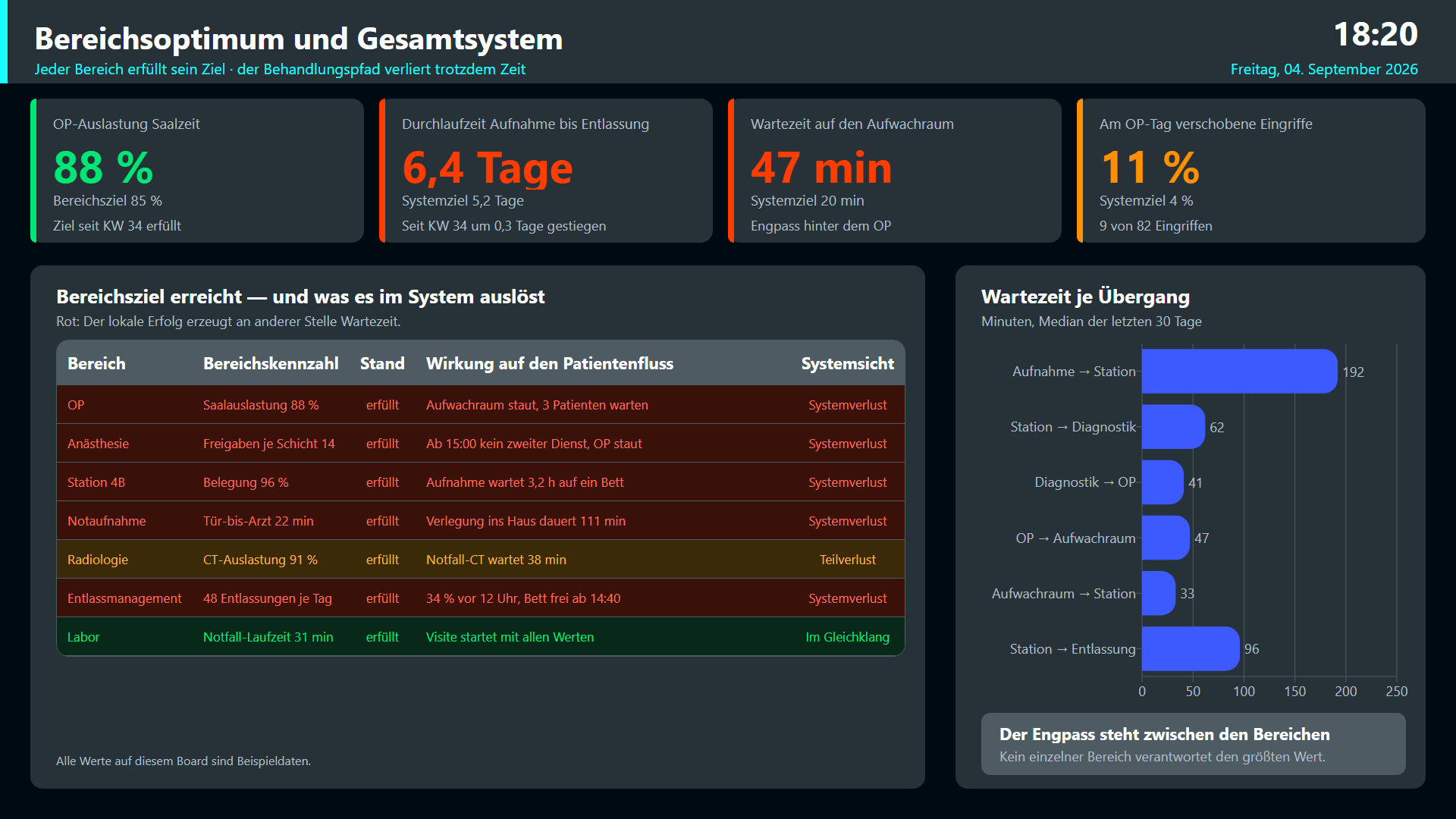
Why does higher theatre utilisation fail to produce more output?
Because the output of a hospital emerges along the patient pathway rather than inside a single department. A theatre can be run well while the patient flow as a whole deteriorates. If utilisation rises without anaesthesia, recovery room and ward moving with it, the bottleneck shifts one station further.
Götz Müller and Ralf Volkmer worked through this example in episode 394 of the Kaizen 2 go podcast. Industry has known the effect for decades: a highly optimised production line delivers little when material flow, maintenance and planning fail to keep up.
Figures from the German Federal Statistical Office show how thin the margin is. In 2024 around 17.5 million people were treated as in-patients, with an average length of stay of 7.1 days; in internal medicine and general surgery it is 5.2 and 5.0 days. Across a five-day stay, every two-hour wait counts.
How does a hospital make conflicts of goals decidable?
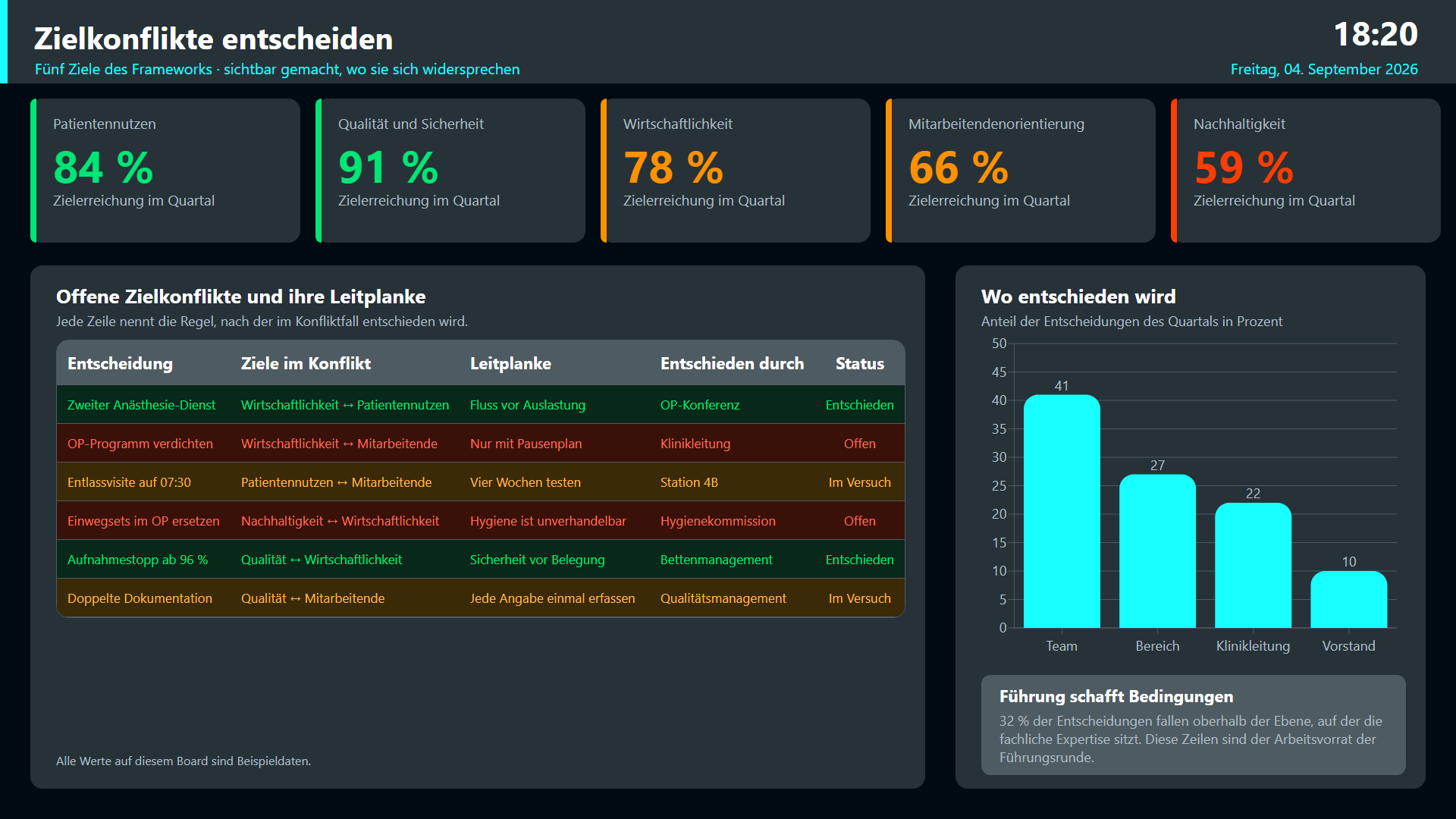
By naming, for every conflict, the rule that settles it. The framework deliberately treats patient benefit, quality, economic viability, staff orientation and sustainability as shared goals. In daily operations they collide anyway, and that is when an organisation reveals its actual decision logic.
A second anaesthesia shift from 3 p.m. costs money and shortens waiting times. A denser theatre programme raises utilisation and loads the teams. Each case becomes decidable once a guard rail exists: flow before utilisation. Safety before occupancy. No densification without a break plan.
What becomes visible is a short list with four columns: decision, goals affected, guard rail, deciding committee. The screen above shows it as an example. Its second part answers a further question: at which level do decisions fall, and does the clinical expertise sit there? All values on this board are invented demo data.
How does the reference frame become a learning experiment?
By picking one concrete problem instead of an implementation initiative. Patient admission, a theatre process or discharge are enough. The examination covers which goals the departments pursue, which metrics they use and where interfaces produce waiting time.
Out of that comes an experiment with four fields: initial condition, target condition, current condition, next step. The form comes from the Toyota Kata described by Mike Rother, a routine in which a manager coaches while the team determines the next step itself. That is what the leadership understanding of the framework aims at: leadership creates the conditions under which the system recognises problems and learns from them.
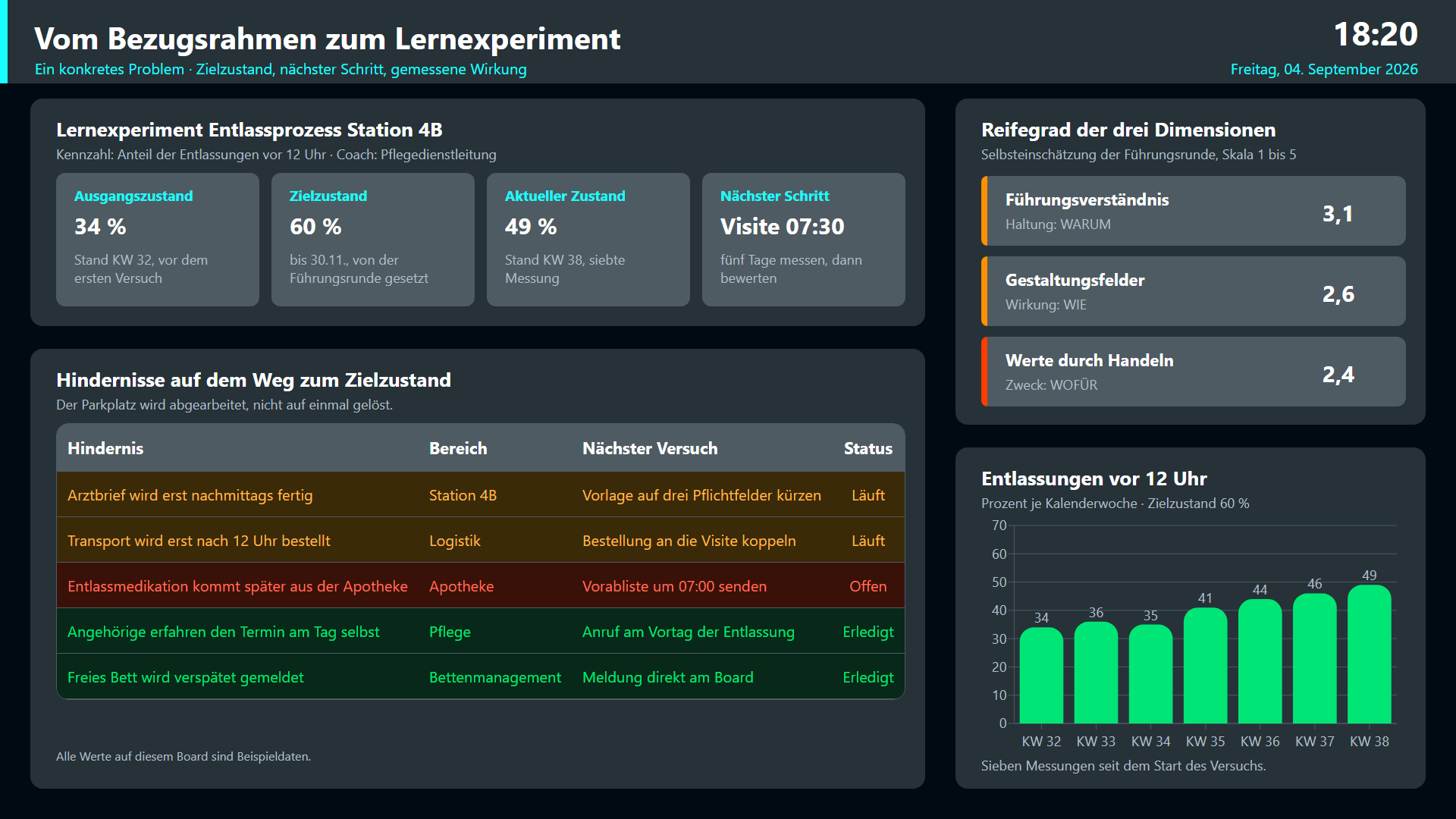
The screen holds the same experiment for the discharge process, with the maturity of the three dimensions and the weekly measurement beside it. That addresses the third open question of the review: how does a hospital recognise that a reference frame has become a leadership system? By routines that can be observed.
Which metrics show the whole system instead of one department?
Five figures are enough when each of them measures the patient’s path across departmental boundaries.
- Lead time from admission to discharge, as a median per treatment pathway.
- Waiting time per handover, for example from theatre into the recovery room.
- Share of procedures postponed on the day of surgery, an early indicator of capacity conflicts.
- Share of discharges before noon, which decides afternoon bed availability.
- Open conflicts of goals with guard rail and ownership, visible to every department involved.
The first four describe flow. The fifth connects the figures to a decision and turns a display into a leadership instrument. How visibility works day to day is described in the article on visual management in hospitals; the maturity of operational control across German-speaking countries is covered in the article on clinical operations in hospitals.
Where does digitalisation help the framework concretely?
It answers three questions on which a reference frame otherwise stalls: which information is missing? Where does waiting time appear? Where does learning happen? All three need data the house already holds, in the hospital information system, in theatre planning and in Excel files.
The example in this article is built with Peakboard. Peakboard is a low-code platform for real-time dashboards from industry (manufacturing and logistics), whose boards work just as well for wards, emergency departments and operating theatre areas. The kinship is one of content: a shop floor board shows lead time, bottleneck and disruption; a hospital board shows length of stay, handover and conflict of goals.
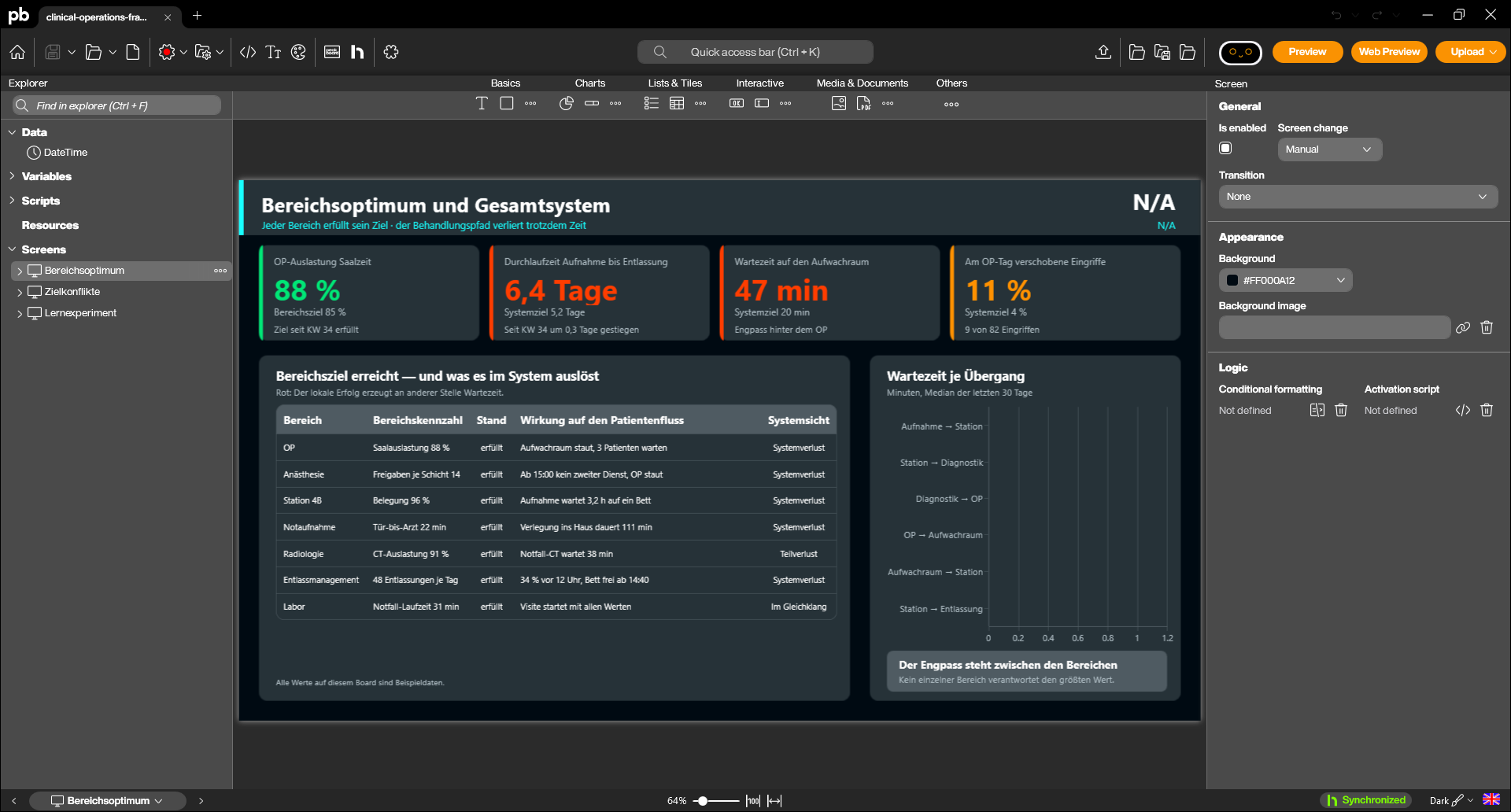
The construction uses standard elements: metric tiles, tables with coloured rows and two chart types. Three screens of this kind come together in an afternoon, once the figures sit in a database or a CSV export.
Trying this out needs no IT project: the Peakboard Designer is free, and the board from this article is available here in the blog. Download clinical-operations-framework-cockpit.pbmx, open it in the Designer and replace the demo values with your own. Every figure on the board is invented; it shows the form rather than the state of a real hospital.
What a framework leaves unsolved
It does not replace the agreement on definitions. “Occupancy” means installed, operable or occupied beds depending on the house, and a shared screen makes that fuzziness visible on every ward at once.
It does not replace the routine either. A reference frame that gets presented and pinned to a wall changes no working day. The decisive question is therefore: what does a hospital do differently today because it understands itself as a whole system?
The paper claims no completeness. It invites experimentation and is meant to grow through scientific findings and practical experience.
What hospitals take away from it
The shortest path from reference frame to effect runs through a single process. A hospital picks discharge, admission or one theatre day, shows departmental targets next to their effect on the pathway, names the guard rails for its two largest conflicts and measures one target condition weekly.
After twelve weeks the review’s question has an answer. A hospital with one management system can name the decisions it took differently because of the whole system. A hospital with many management systems shows project plans. Which methods play together here is set out in the overview on Lean Hospital.
Frequently asked questions about the Clinical Operations Framework
What is the Clinical Operations Framework?
The Clinical Operations Framework is a reference frame by Ralf Volkmer that brings together insights from lean management, operations management, quality and risk management, leadership, organisational development, digitalisation and data management. It consists of three dimensions — leadership understanding, fields of design and values through action — connected by an integrative management system.
Does the Clinical Operations Framework replace Lean Hospital?
No. The author positions the framework explicitly as an addition to lean management and Lean Hospital. Its contribution lies in integration: it creates a shared language for the professions and departments that look at the same hospital through different methodical lenses.
What separates a reference frame from an operating system?
A reference frame describes the purpose and the reasoning of an organisation. An operating system emerges only through leadership principles, standards, routines, metrics, digital support and continuous improvement. The Clinical Operations Framework draws this distinction itself and thereby names the work that still lies ahead in the hospital.
How can a hospital tell the maturity of an integrated leadership system?
By observable routines rather than documents. Four questions carry weight: are departmental targets checked against their effect on the patient pathway? Does every conflict of goals carry a named decision rule? Is at least one experiment running with a target condition and a measurement? And do decisions sit where the clinical expertise sits?
Sources
- Müller, Götz. “Braucht das Krankenhaus ein neues Framework? Eine Rezension des Clinical Operations Framework von Ralf Volkmer.” LeanBase, LeanHospital channel, 31 August 2026. https://leanbase.de/publishing/post/e3zsv-braucht-das-krankenhaus-ein-neues-framework
- Müller, Götz; Volkmer, Ralf. “Kaizen 2 go 394: Clinical Operations Framework.” Podcast episode, GeeMco. https://www.geemco.de/artikel/kaizen-2-go-394-clinical-operations-framework/
- Statistisches Bundesamt (Federal Statistical Office of Germany). “2,0 % mehr stationäre Krankenhausbehandlungen im Jahr 2024.” Press release no. 398, 6 November 2025. https://www.destatis.de/DE/Presse/Pressemitteilungen/2025/11/PD25_398_231.html
- Volkmer, Ralf. “Krankenhäuser erkennen ihre Schwächen – doch das Vertrauen in die eigene Veränderungsfähigkeit bleibt begrenzt.” LeanBase, 29 August 2026. https://leanbase.de/publishing/post/mvpkg-krankenhauser-erkennen-ihre-schwachen-doch-d