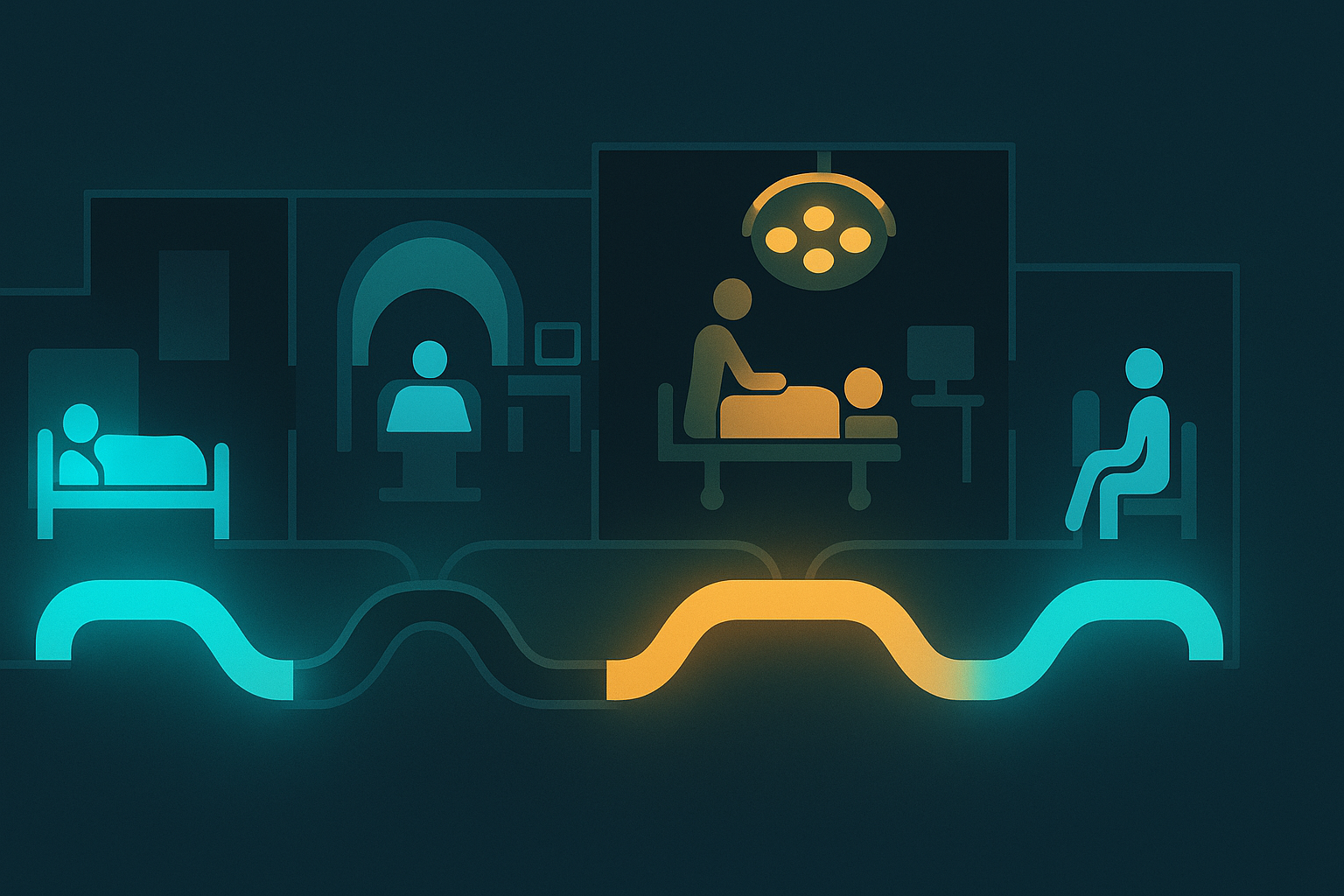
In short: A lean hospital is a hospital that manages the patient pathway as one continuous process and removes everything in it that does not contribute to treatment. A systematic review of 60 hospital studies found reductions in length of stay of between 6.67 and 78 percent and in waiting times of between 11.3 and 88 percent (Wang et al., 2025). On hard clinical outcomes, lean shows no effect on current evidence: the largest included study, covering roughly six million patients, found no change in 30-day mortality. Lean management in hospitals works where teams change their own process, and does harm where it is imposed as a centrally mandated programme.
A patient has been on the ward since yesterday, waiting for an MRI. The scan is not booked, because the request was left in the night shift’s pile. She is medically finished the moment the report lands - but the report depends on a slot, and the slot depends on a piece of paper. Two days later she goes home. One of those days was treatment. The other was waiting. From the hospital’s point of view the bed was occupied; from hers, nothing happened. That gap between occupied capacity and actual value is what lean management in hospitals is about.
What is a lean hospital?
A lean hospital is a hospital that manages the entire patient pathway from admission to discharge as one connected process and consistently removes any activity that does not contribute to treatment. That includes waiting, searching, duplicate documentation, chasing information and unnecessary transport. The method comes from the Toyota Production System and was transferred to hospitals from the early 2000s onwards.
The pivotal shift lies in the question a team asks. The familiar question is: how do we get through the workload with the staff we have? The lean question is: where does this patient spend time in which nothing happens for them? The first question leads to work intensification. The second leads to a visible process in which interruptions become recognisable as interruptions.
Miss that distinction and you get work intensification with a lean label on it. It is the most common and most damaging failure mode in this field, and most of the evidence on dissatisfied staff further down this article traces back to it.
The five principles of Womack and Jones
Lean comes out of the Toyota Production System that Taiichi Ohno built from the 1950s onwards. James Womack and Daniel Jones condensed the logic in Lean Thinking (1996) into five principles that still frame the field.
- Specify value - from the point of view of the person receiving the service, which in a hospital is the patient. Value-adding work is what contributes to diagnosis, treatment or recovery.
- Map the value stream - record every step from first contact to discharge, including the waiting in between. The tool for this is value-stream mapping: a record of the actual sequence, with times.
- Create flow - reduce handovers, queries and idle time between steps so that a case runs through without interruption.
- Establish pull - the next step pulls the work instead of the previous one pushing it into a queue. On a ward that means diagnostics signalling free capacity rather than requests piling up.
- Pursue perfection - make improvement a daily routine, known as continuous improvement or kaizen.
In a hospital the third principle is the hardest. A patient moves through admission, diagnostics, ward, theatre and discharge as one journey, while the hospital is organised into departments that each optimise their own utilisation. It is precisely at these departmental boundaries that the waiting arises which the patient experiences as length of stay.
Why the topic is pressing now
The financial position of German hospitals has sharpened considerably. According to the German Hospital Institute’s Krankenhaus-Barometer, roughly two-thirds of hospitals closed 2024 in deficit; for 2025, 70 percent expected a negative result, and only one hospital in seven anticipated a positive one (DKI, Krankenhaus-Barometer 2025).
At the same time, staffing is heading into a demographic wall. The German Hospital Federation notes that hospitals have added substantial staff since 2000 - more than 409,000 nursing full-time equivalents in 2024 - but that around 300,000 employees will retire by 2035. Administrative load compounds it: 96 percent of surveyed hospitals describe the bureaucratic effort of staffing-assessment instruments as excessive (DKG, 2026).
The combination is the real driver. Hiring your way out is neither affordable nor demographically available. What remains is the question of how much of the existing working time actually reaches the patient. That is the question lean management answers.
What the evidence supports
At the process level, the data are now reasonably solid. A 2025 systematic review examined 60 studies of lean implementation in hospitals and found substantial effects on efficiency measures across the included work: length of stay fell by between 6.67 and 78 percent depending on the study, waiting times by between 11.3 and 88 percent, and three studies reported operating-cost reductions of between 8.7 and 80 percent. Lean was most often deployed in large public hospitals and, within them, in the bottleneck areas - emergency departments, operating rooms and pharmacies (Wang et al., International Journal of Health Policy and Management, 2025).
Those ranges are deliberately wide, and they should be read that way. They show what lean can do rather than what it will do. A 78 percent reduction in length of stay comes from a narrowly scoped single process, not from a whole hospital.
The results are most robust where the bottleneck is named explicitly. The emergency department is the standard case: crowding arises mostly at the exit, because admitted patients cannot get a ward bed, and it has measurable consequences for quality of care. That link is documented at length in a separate article on emergency department crowding.
The best-known individual hospitals belong in this picture too. Virginia Mason in Seattle and ThedaCare in Wisconsin adopted the Toyota Production System in the early 2000s and documented their results - space freed up, shorter lead times, fewer steps walked. What those hospitals actually measured is covered in the article on Virginia Mason and ThedaCare.
And where the evidence does not hold
This is the uncomfortable part, and it is missing from most accounts. The methodologically strictest review of the field reaches a markedly more cautious conclusion. Moraros, Lemstra and Nwankwo assessed 22 papers that passed a quality appraisal and found no statistically significant association between lean interventions and either patient satisfaction or health outcomes. The largest included study, covering roughly six million patients, showed no effect on 30-day mortality.
Two further findings from the same paper weigh heavier than the null result. First, there was a negative association with worker satisfaction: in a Saskatchewan Union of Nurses survey (n = 1,173), all 15 measured outcomes came out negative, including nurse engagement and nurses’ perception of patient safety. Second, the financial picture was dismal: on this analysis Saskatchewan spent $1,511 on lean interventions for every $1 saved - $52 million invested against $56,934 in documented savings. The authors’ verdict is blunt:
“While some may strongly believe that Lean interventions lead to quality improvements in healthcare, the evidence to date simply does not support this claim.”
(Moraros, Lemstra & Nwankwo, International Journal for Quality in Health Care, 2016)
A review of reviews in BMJ Open arrives at a related conclusion from a different angle: the immaturity of the research field makes it hard to find substantial evidence for effective lean interventions in healthcare (Andersen, Røvik & Ingebrigtsen, 2014).
How do these fit together? Most plausibly like this. Lean reliably improves what it directly addresses - lead times, waiting times, process steps. It does not automatically improve what sits many steps downstream, such as mortality or satisfaction. And it can do active harm when it is imposed as a centrally mandated programme with expensive external consultancy rather than carried by the teams doing the work. The Saskatchewan case is not an argument against lean; it is an argument against lean as a mega-project.
For practice this implies a sober set of expectations. A lean initiative that opens with a promise of better clinical outcomes promises more than the evidence supports. One that addresses a specific waiting time and measures it delivers.
What waste actually looks like in a hospital
Taiichi Ohno described seven types of waste, known in lean vocabulary as muda. Translated to a hospital, they become very concrete everyday observations.
| Type of waste | How it shows up in a hospital |
|---|---|
| Transport | patient transfers across the site, material runs between store and ward |
| Inventory | overfilled store rooms, expired sterile goods, duplicated consumables |
| Motion | nurses’ walking distances, hunting for a drip stand, a BP monitor or a chart |
| Waiting | waiting on a consult, a result, portering, a signature, a free bed |
| Overproduction | duplicate documentation on paper and in the system, reports nobody reads |
| Overprocessing | routine diagnostics without indication, histories taken repeatedly |
| Defects | readmissions, rework after an incomplete handover, lost results |
The eighth type, added later, weighs particularly heavily in hospitals: unused staff potential. When a nurse knows why the ward round jams every Tuesday and nobody asks her, that is the same waste as an idle operating theatre.
The practical value of this list is that it cannot be argued with. Anyone who spends a shift recording how often a nurse searches for something has a defensible baseline. That is exactly the purpose of the gemba walk - the walk to the place where the work actually happens: look, instead of guessing from a meeting room.
The seven areas, in brief
What gets discussed in practice under “lean in hospitals” clusters into seven areas.
| Area | What it covers |
|---|---|
| Daily management & metrics | Short daily stand-up at a board, a cascade of measures, a defined escalation path |
| Culture, leadership & change | Leading by enabling, gemba walks, continuous improvement |
| Patient flow & processes | Admission, diagnostics, theatre and discharge as one value stream rather than departments |
| Lean in nursing | Walking distances, search time, interruptions, standardised handover |
| Digitalisation & real-time data | Transparency on occupancy, status and delays - without new manual data entry |
| Strategy | A goal cascade from the executive board down to the ward, usually via hoshin kanri |
| International learning | Lessons from the US pioneers, critically translated to a DRG system |
Two of these areas are already covered in depth on this blog. How a status board and the daily huddle work, and where their limit lies, is set out in the article on visual management in hospitals. Why the handover is the most fragile point in care, and what structured formats such as SBAR and I-PASS change about it, is covered in the article on the structured handover.
How a hospital starts with lean
The hospitals with the most convincing results started small. A workable entry point for a single ward or department has five steps.
- Pick a process that hurts. A good candidate has visible waiting and a clear boundary: morning discharges, requesting imaging, the handover to the late shift.
- Record the current state at the place of work. Walk one shift, note times, count interruptions. Without a baseline, every later improvement is an assertion.
- Choose a measure the team itself influences. The share of discharges completed before noon is controllable. The hospital’s average length of stay is not, from a ward’s point of view.
- Introduce a daily routine. Ten minutes standing at a visible board, at the same time every day, with a fixed question: what jammed yesterday, who is on it, by when.
- Agree an escalation path. Any problem the ward cannot solve itself goes up one level with a name and a deadline. Without that route, the board loses its credibility within weeks.
None of these five steps needs a capital budget. They need leadership attention, every day, for months - and that is exactly where most programmes fail.
Why lean programmes fail in hospitals
Three patterns recur in the literature and in practitioner accounts.
The tool arrives before the question. A hospital decides to roll out 5S and labels cupboards without anyone having measured how much time is actually lost searching. The method is applied correctly and still has no effect, because it addresses no real bottleneck.
The programme belongs to head office. A central function rolls lean out across all departments to plan, supported by external consultants and a milestone chart. That is precisely the Saskatchewan configuration, and the balance there was negative both financially and culturally.
The numbers are produced by hand. A ward manager collects figures from three systems every morning and writes them on a whiteboard. That works for eight weeks. Then individual days go missing, and eventually an out-of-date board sits on the wall - which is worse than none at all, because nobody trusts it any more.
How the numbers reach the board without extra data entry
The most underestimated item on the whole list is data collection. Many lean routines fail on the fact that somebody has to assemble the numbers by hand every morning - and eventually stops - rather than on the method.
Where occupancy, result status or the theatre schedule already sit in source systems, the question shifts. It is no longer whether a ward runs a board, but whether that board updates itself. A screen that pulls occupancy, open consults and planned discharges live from the source systems keeps the daily routine alive even after a punishing shift.
Peakboard is a low-code platform for real-time dashboards from industry (manufacturing and logistics), whose boards work just as well for wards, emergency departments and operating areas. The documented deployments come predominantly from production and warehousing; extending them to a ward or theatre board is an extension of those industrial principles and not a claim to published clinical results.
A board like this can be tried without an IT project: the Peakboard Designer is free, and a ready-made template for a ward status board is available for download in the article on visual management in hospitals.
The transferable lesson
Lean in hospitals is neither the rescue nor the rebranding exercise it is alternately sold as. The defensible claim is narrower than both, and more useful: when a team makes its own process visible and works systematically on the waiting inside it, the process gets measurably faster. Whether that becomes better clinical outcomes is not established - and whether it helps or harms the staff is decided by who holds the method rather than by the method itself.
That is why the hospitals with the most convincing results almost never started with a tool. They started with a question: where does this patient spend time in which nothing happens for them? Everything else - board, huddle, value-stream map, metric - is only the answer to that question.
Frequently asked questions about the lean hospital
Is lean in hospitals just another word for staff cuts?
Lean in hospitals targets waiting time, search time and duplicate work rather than posts. Where lean is introduced as a savings programme, it backfires: the review by Moraros and colleagues found that in a survey of 1,173 nurses in Saskatchewan, all 15 measured outcomes came out negative, including engagement and nurses’ perception of patient safety.
How long does it take for lean to show an effect in a hospital?
A single bounded process shows an effect within weeks: a structured handover or a scheduled diagnostics request can be measured within one quarter. A hospital that runs on lean principles throughout needs years, because leadership routines have to change. Virginia Mason has been building its production system since 2002.
Does a hospital need external consultants for lean?
External consultancy helps at the start and is expensive as a permanent arrangement. On the analysis by Moraros and colleagues, Saskatchewan invested $52 million in an externally driven lean programme and documented $56,934 in savings. The more durable route is to qualify a few of your own people who translate the methods into ward reality.
Where should a single ward start?
A ward starts with a ten-minute daily stand-up in front of a visible board and exactly one measure the team can influence itself - for example the number of discharges completed before noon. Method training, value-stream mapping and software come afterwards.
How does lean differ from hospital quality management?
Quality management checks whether defined standards are being met and documents that for certification. Lean management changes the process itself and makes improvement a daily task for the team at the place of work. Both systems use the PDCA cycle and complement each other when quality management supplies the measurement.
Sources
- Womack JP, Jones DT. Lean Thinking: Banish Waste and Create Wealth in Your Corporation. Simon & Schuster, 1996.
- Wang J, Lv H, Chen M, et al. “A Systematic Review of Lean Implementation in Hospitals: Impact on Efficiency, Quality, Cost, and Satisfaction.” International Journal of Health Policy and Management, 2025;14:8974. https://www.ijhpm.com/article_4774.html
- Moraros J, Lemstra M, Nwankwo C. “Lean interventions in healthcare: do they actually work? A systematic literature review.” International Journal for Quality in Health Care, 2016;28(2):150-165. https://pmc.ncbi.nlm.nih.gov/articles/PMC4833201/
- Andersen H, Røvik KA, Ingebrigtsen T. “Lean thinking in hospitals: is there a cure for the absence of evidence? A systematic review of reviews.” BMJ Open, 2014;4(1):e003873. https://pmc.ncbi.nlm.nih.gov/articles/PMC3902334/
- Deutsches Krankenhausinstitut. “Krankenhaus-Barometer, Umfrage 2025.” DKI, 2025. https://www.dkgev.de/fileadmin/default/Mediapool/1_DKG/1.7_Presse/1.7.1_Pressemitteilungen/2025/2025-12-29_Anlage_DKI-Krankenhaus-Barometer.pdf
- Deutsche Krankenhausgesellschaft. “Starker Personalzuwachs ist kein Grund zur Entwarnung beim Fachkräftemangel.” Press release, 19 March 2026. https://www.dkgev.de/dkg/presse/details/starker-personalzuwachs-ist-kein-grund-zur-entwarnung-beim-fachkraeftemangel/