In short: Standard work in nursing describes the recurring routines of a shift by time, location, responsibility and aid. Jörg Gottschalk argues in his podcast “Krankenhausführung neu denken” that the more complex medicine becomes, the simpler the organisation has to be. Germany’s Federal Statistical Office counted 553,400 people in the nursing service of German hospitals in 2024, 44.6 percent of all non-medical staff. Every minute a ward loses daily to searching and asking around multiplies by that number.
The episode “Die schöne Welt der Schwester Philin” tells an ordinary shift. Philin works on a ward where supplies sit in the right place, information is complete, rounds are coordinated and every task carries a name. She searches for nothing and chases nobody by phone. This article turns Philin’s day into a screen.
What is standard work in nursing?
Standard work in nursing is the agreed sequence of the recurring tasks of a shift. It defines what has to be done, when it has to be done, where it happens and which aid is needed for it. The clinical decision at the bedside stays untouched.
The term comes from Lean management, where it describes the best known way of doing a repeating task. In nursing it covers the handover, the medication round, the ward round, the supply round and discharge preparation. Those five processes fill most of an early shift.
The distinction from control matters. A standard describes a sequence and makes it checkable. Its purpose is orientation: someone who knows what comes next avoids deciding every morning where to begin.
Why must the organisation get simpler as medicine gets more complex?
Because both forms of complexity are paid for out of the same attention. A nurse has a limited amount of concentration per shift. Whatever flows into the question “where is that kept again?” is no longer available for observing a patient.
Gottschalk’s argument inverts a widespread explanation. Healthcare often blames organisational disorder on the unpredictability of medicine: varying disease courses, sudden deterioration, emergencies without an appointment. That falls short, because much of the daily burden comes from search time, interruptions, missing information and unclear agreements.
The reversal is uncomfortable. Organisational disorder follows from missing routine, and it prevents clinical competence from taking effect. The less predictable medicine is, the more reliably everything predictable has to work.
What does a day look like on a ward whose organisation carries it?
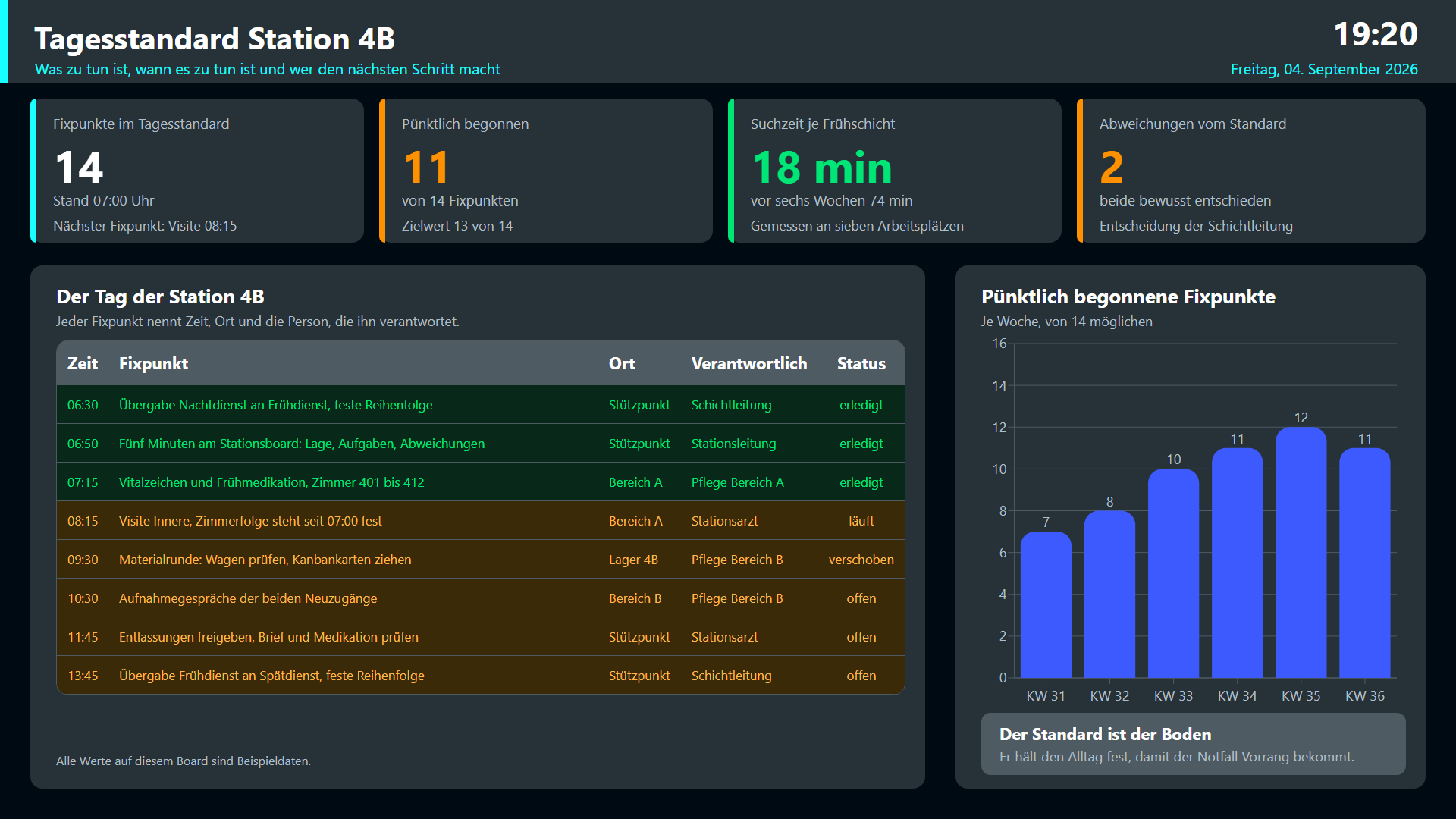
It consists of a few fixed points and a lot of free space between them. The image above is the first screen of a board we built for this article: the daily standard of a fictional ward 4B, with fourteen fixed points, eight of them in the early shift, each carrying a time, a location and an owner.
The list reads unspectacularly, and that is its purpose. Handover at 06:30 in a fixed order, five minutes at the board at 06:50, vital signs from 07:15, the ward round at 08:15 following a room sequence set at 07:00. Nobody asks when the round arrives or who runs the admission interviews.
Every value on this board is invented sample data. The podcast episode and the Lean Knowledge Base article publish no figures; the board shows the shape of such a view, never a real ward.
Where does an early shift lose its time?
To walking, to searching and to asking around. The German Hospital Institute measured around 2 hours and 10 minutes per nurse and working day for non-nursing and non-patient activities in a 2002 survey, a good 28 percent of working time in a 38.5-hour week. Documentation was the largest single block, followed by patient escorting and transports.
That time spreads across many small events, which makes it stubborn. A single walk to the store room takes two minutes. Forty such walks produce a shift that ends without anyone knowing where the hour went.
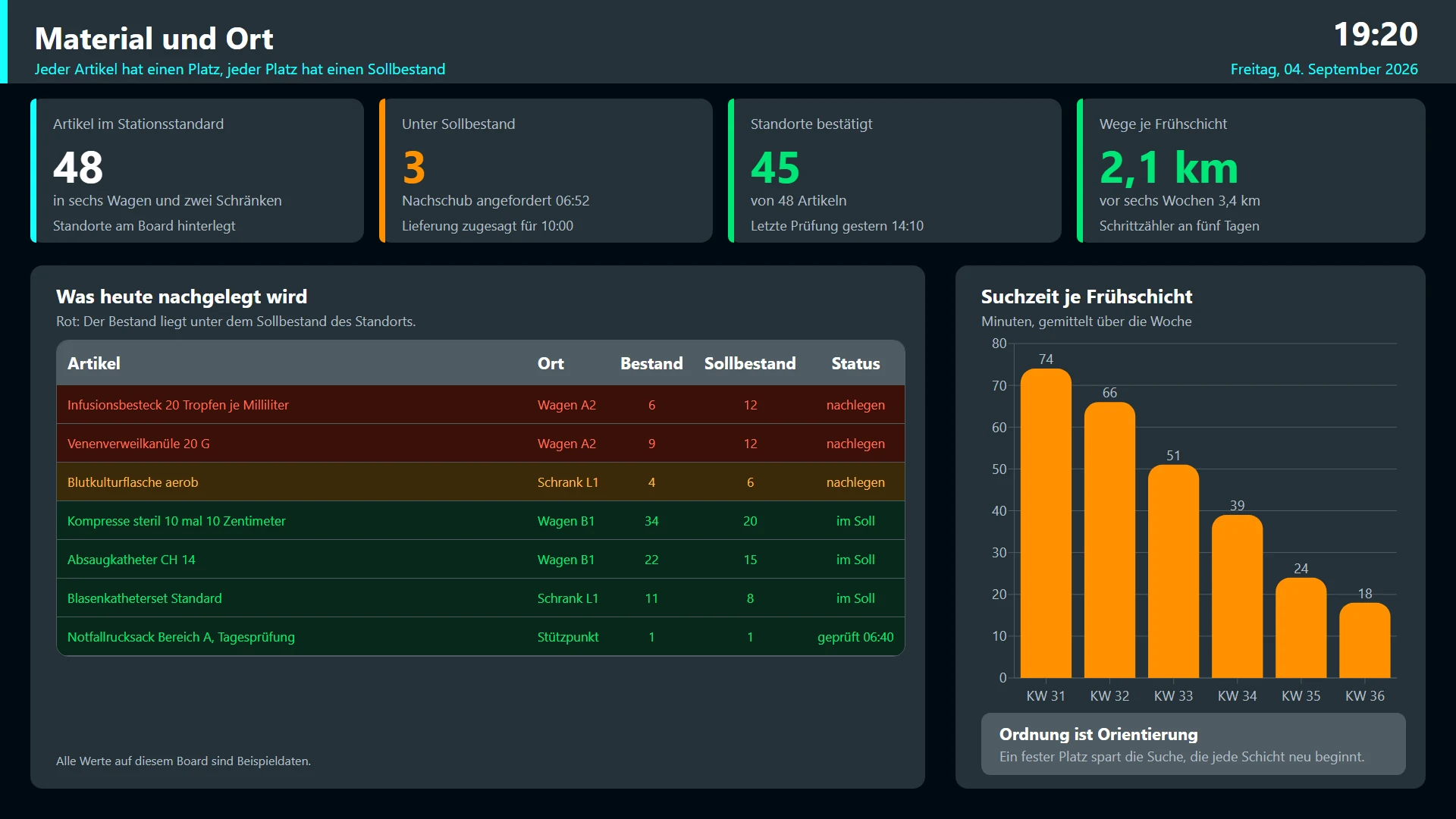
The second screen makes the block visible. It lists the items of the ward standard with location, stock and target level, marks the three positions below target in red, and shows search time per early shift over six weeks: down from 74 minutes to 18. A fixed place and a visible target level do the rest.
What does a digital ward board add to standard work?
It brings the standard to the place where the work happens. A paper plan in a folder describes the sequence once. A screen in the nurses’ station shows which fixed point is next, which stock has dropped below target and which task lacks a name today.
Four effects are reachable within weeks. First, the next step stands there with time, location and owner. Second, stock levels report themselves before somebody faces an empty shelf. Third, the handover follows one sequence, because both shifts see one view. Fourth, single cases become a measurable series.
The example here is built with Peakboard. Peakboard is a low-code platform for real-time dashboards from industry (manufacturing and logistics), whose boards work just as well for wards, emergency departments and operating areas. The kinship is substantive: a production control board shows takt, stock and disruption, a ward board shows fixed point, target level and deviation.
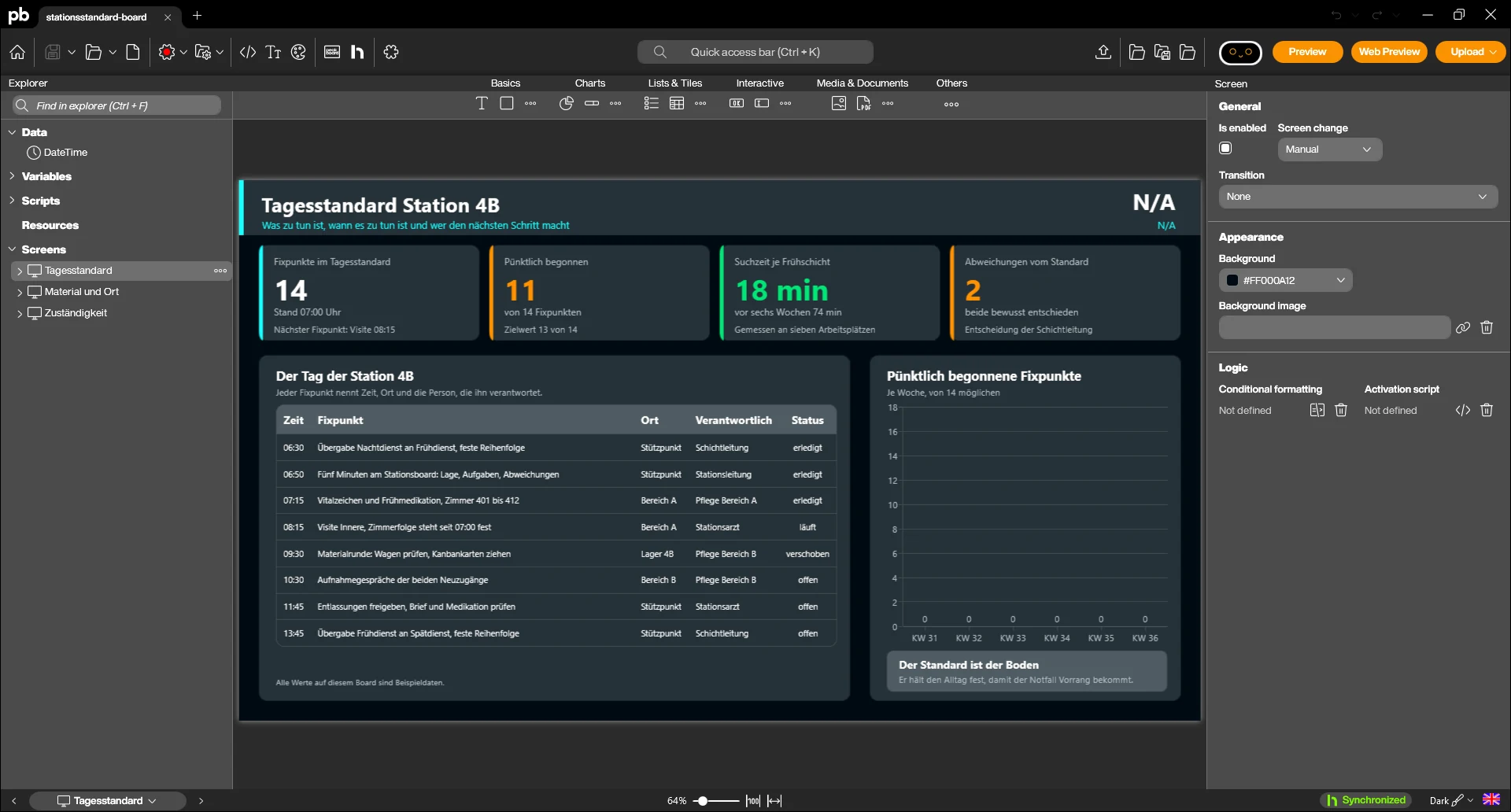
Trying it needs no IT project: the Peakboard Designer is free, and the board from this article is available here on the blog. Download stationsstandard-board.pbmx, open it in the Designer and swap the sample values for your own. It uses standard elements: metric tiles, tables with coloured rows and one chart type.
Why is only the mix of digital and human complete?
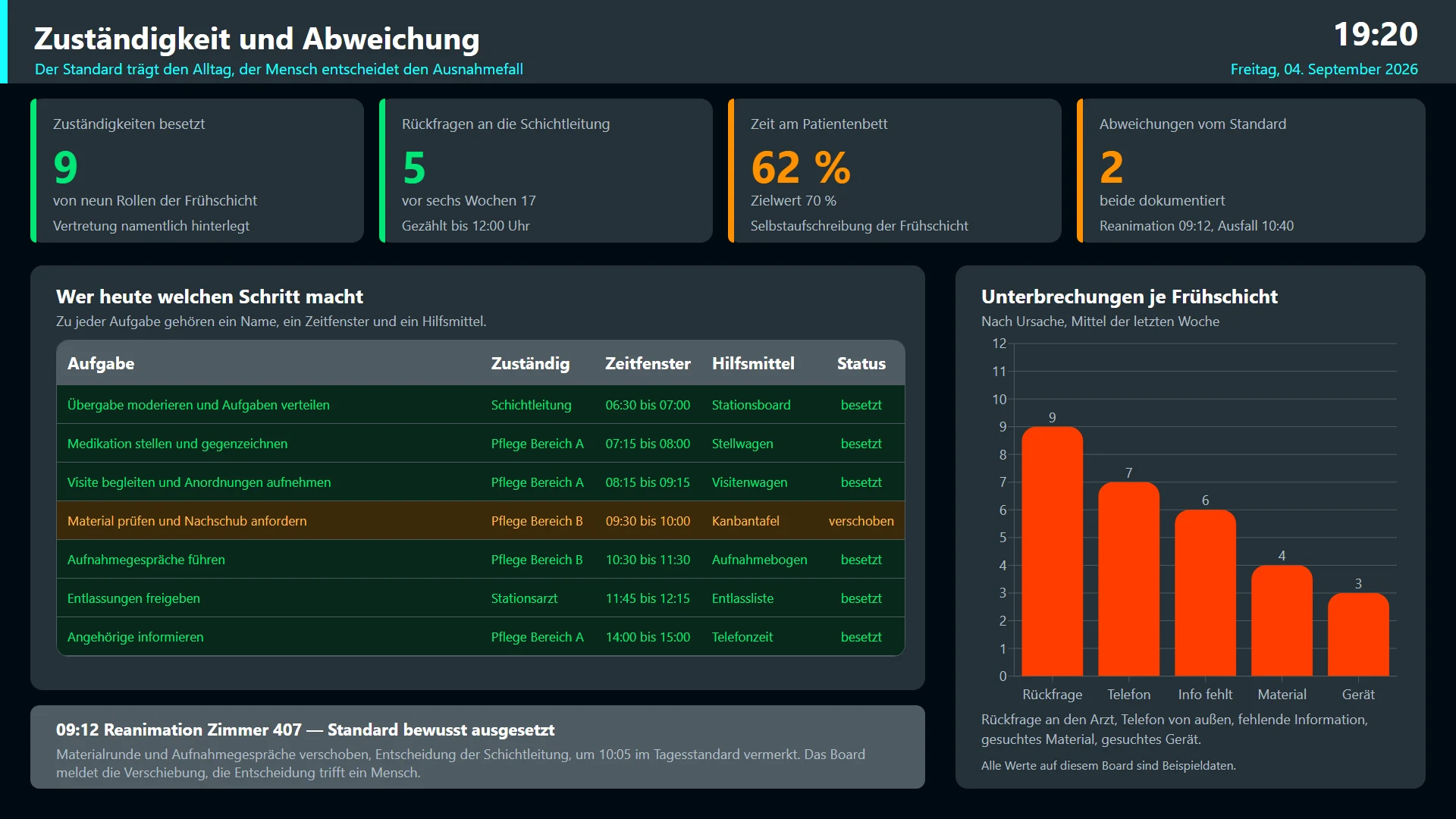
Because a board describes a situation and a person judges it. The third screen shows both: on the left the tasks of the early shift with name, time window and aid, at the bottom the note about the resuscitation at 09:12, where the shift lead moved the supply round and the admission interviews.
That is the decisive moment. The standard was suspended, a person made the call, and by 10:05 it stood in the daily standard. A system deciding such a shift on its own would miss the point: an emergency is precisely what experience and judgement exist for.
The division of labour is therefore describable. The machine reminds, counts and records, because it forgets nothing. The person weighs, decides and explains, because they see the individual case. The column chart on the same screen marks the boundary: the standard answers four of the five most frequent interruptions, and the fifth needs a conversation.
What a ward board does not deliver
It replaces no staffing calculation. A ward short of three people stays short of three people, however visible each fixed point is. A board shows the gap and leaves it open.
It also settles no definitions. “Prepared” means drawn up, checked or signed off, depending on the ward. A shared screen shows that vagueness to everyone at once, and the clarification remains a leadership task.
And a standard without participation survives under four weeks. Designing a ward’s day at a desk produces a plan nobody uses. The sequence that holds comes from the shift that works it, a step described in the piece on visual management.
How a ward starts within eight weeks
With a single process. A ward picks the task people complain about most, writes it down with the early shift in eight lines and posts it where everyone sees it. Two weeks follow in which nothing happens, except that every deviation gets noted.
Those notes produce the second version, and only then is a screen worth it. A board displays a standard that exists; it creates no missing one. After eight weeks a ward can answer two questions: how often the sequence held, and what broke it when it did not.
The same logic applies one level up, when a handover sits between two departments. Why improvements stall there is covered in the piece on silo thinking in hospitals; how Lean, quality management and visual control fit together across a hospital is covered in the overview Lean Hospital.
Frequently asked questions about standard work in nursing
What is standard work in nursing?
Standard work in nursing is the agreed sequence of the recurring tasks of a shift: what has to be done, when, where it happens and which aid is needed for it. It describes the routine of the working day and deliberately leaves the clinical decision in the individual case open.
Does a fixed standard restrict nursing judgement?
A fixed standard restricts nursing judgement once it also governs the clinical decision. Standard work describes the organisational routine, meaning times, locations and responsibilities. That routine is exactly what creates the room in which a nurse can respond to an emergency without the rest of the day collapsing.
How much time does a nurse lose to organisation?
The German Hospital Institute measured around 2 hours and 10 minutes per nurse and working day for non-nursing and non-patient activities in a 2002 survey, a good 28 percent of working time in a 38.5-hour week. Searching, documenting, transporting and asking around account for most of it.
What does a digital ward board have to do with standard work?
A digital ward board shows the standard where the work happens. It names the next fixed point with time, location and owner, reports stock below the target level and records deviations. The decision about a deviation stays with a person, and the board makes that decision visible.
Sources
- LKB Redaktion. “Je komplexer die Medizin, desto einfacher muss die Organisation sein.” LeanBase, channel LeanHospital, 17 August 2026. https://leanbase.de/publishing/post/je-komplexer-die-medizin-desto-einfacher-muss-die
- Gottschalk, Jörg. “Die schöne Welt der Schwester Philin.” Podcast Krankenhausführung neu denken, 2026.
- Federal Statistical Office of Germany. “2.0% more inpatient hospital treatments in 2024.” Press release No. 398 of 6 November 2025. https://www.destatis.de/DE/Presse/Pressemitteilungen/2025/11/PD25_398_231.html
- German Hospital Institute. “Pflegefremde/patientenferne Tätigkeiten im Pflegedienst der Krankenhäuser – Studie zur Ermittlung ihres zeitlichen Aufwandes.” Research project, 2002. https://www.dki.de/forschungsprojekt/pflegefremde-patientenferne-taetigkeiten-im-pflegedienst-der-krankenhaeuser-studie-zur-ermittlung-ihres-zeitlichen-aufwandes